Keep the receipts

@wintaru · Oct 11, 2026 · 5 min read
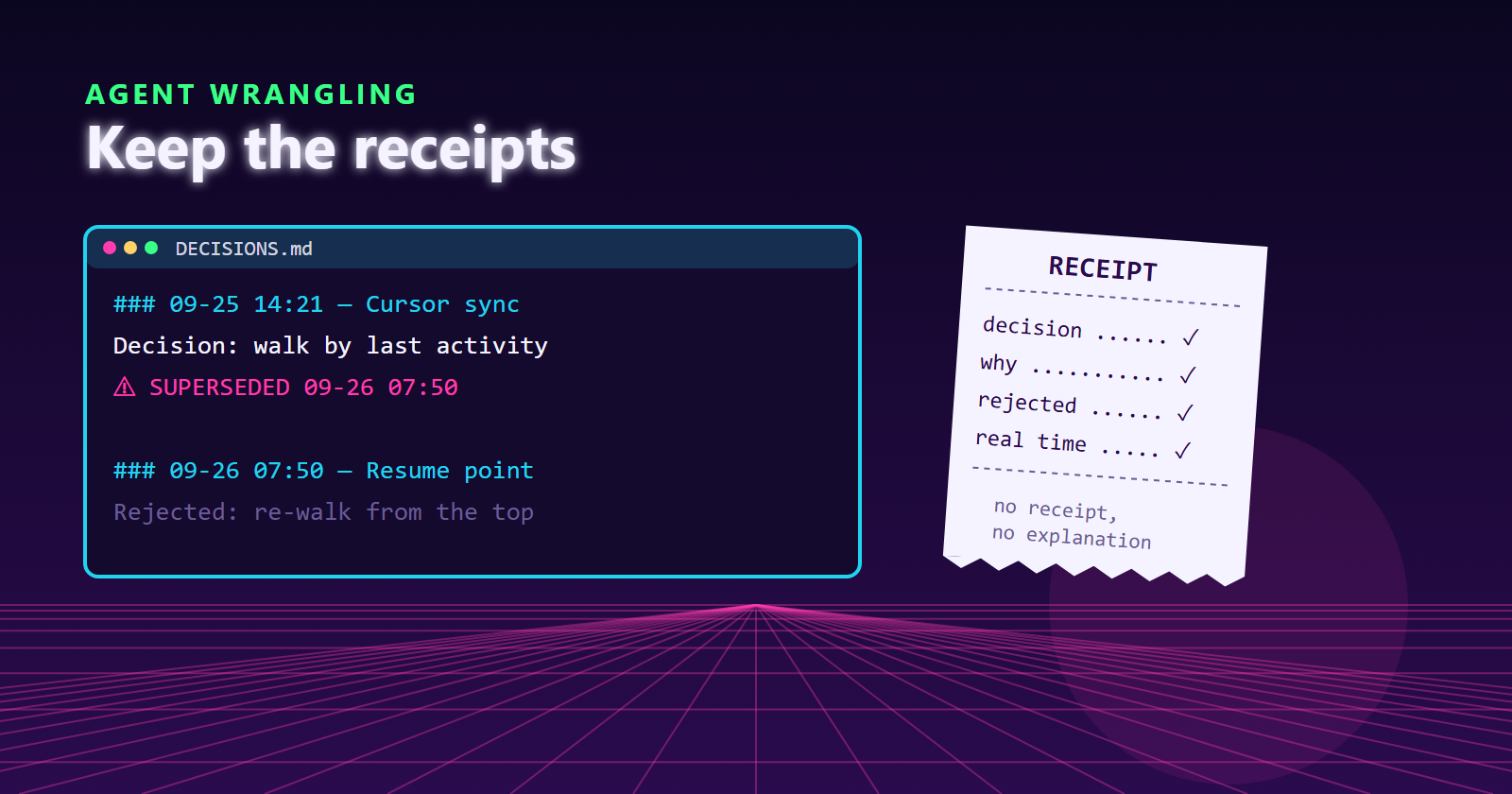
If you let an AI agent make choices in your code, sooner or later someone will ask you why it's built that way. This post is about a small habit that gives you an answer: the agent writes down each real decision, with the reason and the option it turned down, while the work is happening.
In my setup this is a skill called receipts. (A skill is a set of instructions Claude Code loads when it needs them.) It keeps a file called DECISIONS.md in the project. It's been on in every session since July, and my work laptop now has about 400 entries across 10 projects.
Why I wanted it
I built it first for timeboxed work, like an interview take-home or a feature with a deadline, where you have to walk someone through your choices afterward. The tricky part with an agent is that some of those choices were never really yours. The model picked a library or a pattern, it worked, and you moved on. A week later you can't say why.
The commit message doesn't help much either. It explains the final state, not the three things you tried on the way there.
So the agent keeps the receipts as it goes. I'd tell you a joke about decision logs, but I'd have to explain why I picked it. (Luckily, it's in the log.)
What an entry looks like
Each entry is short: what was picked, why, and what lost.
### 2026-09-23 19:15 — Autostart via a logon task
- Decision: start the dashboard from a Task
  Scheduler logon task
- Why: <the reasoning>
- Alternative considered: the Startup folder,
  and why it lost
There's a second kind of entry for language features. If the agent uses something non-obvious, like an odd library call or a type trick, it logs what that thing actually does underneath and why it fits here better than the plain option. "Why did you use that?" is a common review question, and it's the hardest one to answer when the model wrote the line.
Three rules that make it worth reading
Only real forks. A session that fixes a typo leaves no file behind. Fifteen trivial entries bury the five that matter.
A real clock. Every heading has a full date and time, and the agent gets it by running date, not by guessing. Early entries had only a time, like "14:32". A bare time can't be lined up with a commit a week later, and a made-up one is worse.
Never delete a wrong entry. Mark it. This is the one that earns its keep. When later work proves an entry wrong, the agent goes back and puts a SUPERSEDED marker on it, with the date, what changed, and a pointer to the new entry. The old reasoning stays.
That rule came from a bug. An entry in one of my logs recorded a reason that later turned out to be the cause of a defect. Nothing in the file said so, so it still read like current advice a month later, which is roughly how the bug lived that long. A wrong reason that looks current is worse than no reason, because the next reader follows it. Often that next reader is another agent.
A real chain
My work dashboard reads a busy Teams support channel and keeps a summary of each thread. Getting the sync right took three tries in two days, and the log shows all three:
- First plan: walk through the threads in two-week windows, by the date on each thread's first post. Then a live check showed that date doesn't change when someone replies, so busy threads would get skipped. Marked superseded.
- Second plan: walk by each thread's real last activity, starting from the newest every run. On the next real run it spent all 20 minutes re-checking threads it had already read, and timed out. Marked superseded.
- Third plan: save a resume point so each run picks up where the last one stopped.
Anyone reading that file sees the dead ends and why each one died. That's the part you can't rebuild from the code.
Getting it back out
When I need to explain the work, I ask for /receipts summary. Claude reads the log and turns it into a short list of talking points. It puts the non-obvious choices first, since those get asked about, and it calls out the reversals. "We tried X, it broke because Y, so now it's Z" is the strongest thing you can say in a review, not something to hide.
As of today the log has a second reader. My new walkthrough skill, which goes through a set of changes with me one piece at a time, reads DECISIONS.md first. When it explains why a chunk of code looks the way it does, it cites the entry and its timestamp, instead of making up a reason after the fact.
If you want to try this without my setup, the idea fits in a few lines of instructions for any agent: log real forks only, stamp them from the clock, and mark wrong entries instead of deleting them. I also wrote about the rest of my agent's memory, like hand-off files and a task list, in part 7 of my agentic layer series.
Drafted with an assistant, edited by @wintaru
0 comments