Build your own agentic layer, part 8: keeping myself in the loop

@wintaru · Oct 8, 2026 · 4 min read
Part 8 of a series on building your own agentic layer. Part 7 covers memory and teaching the agent my preferences.
Everything so far makes the agent do more on its own. That has a cost: I can stop understanding my own code. One line in Trillian's rules says it plainly:
I don't want to get complacent and outsource all my thinking to you.
So Trillian has a learning posture. It's a set of skills that are on by default in every session, and their whole job is to keep me in the loop.
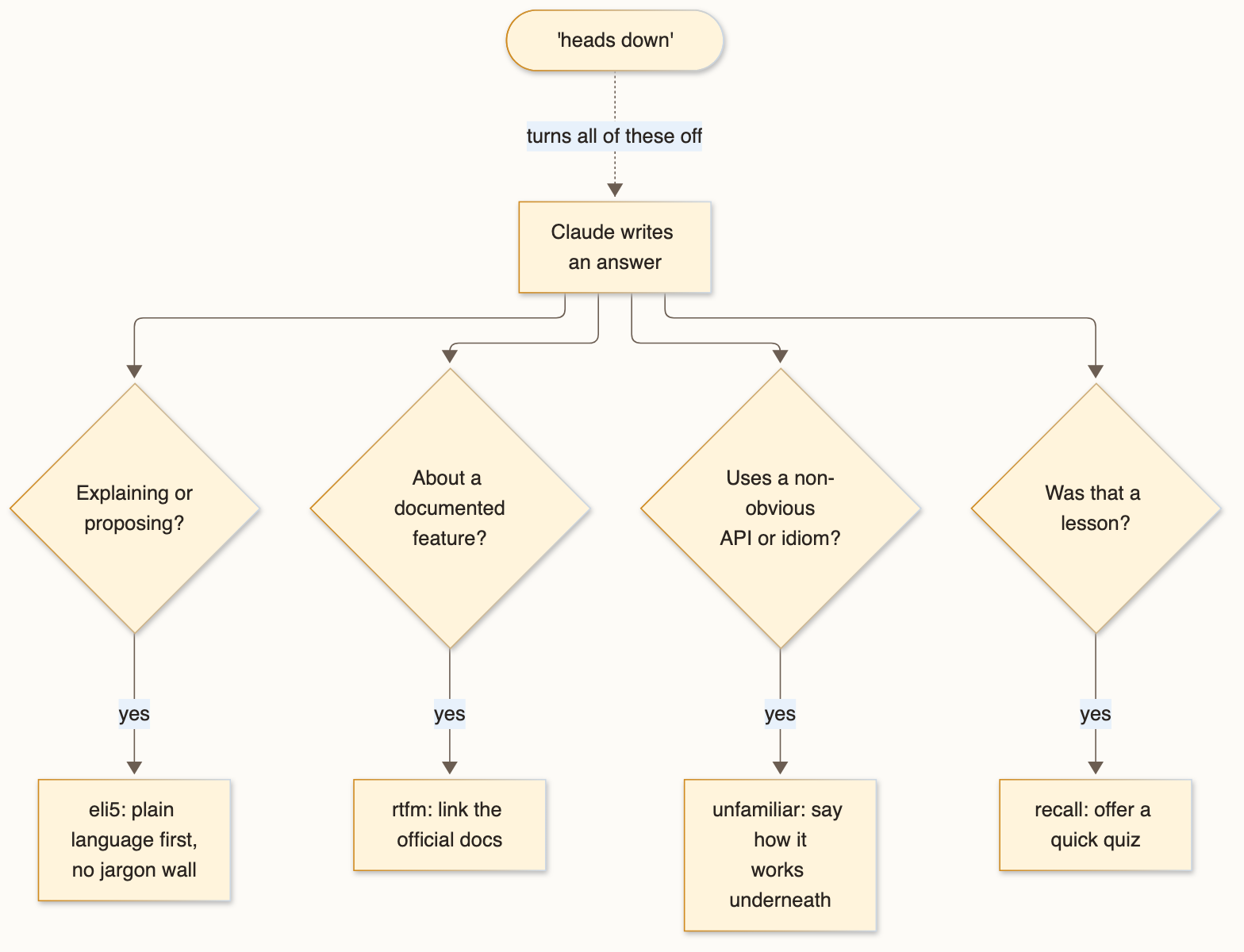
The four that are always on
eli5 ("explain like I'm 5"). Every explanation and every proposal comes in plain language first: a few sentences, no jargon. The technical version only shows up when I ask for it.
rtfm. Any answer about a documented feature of a specific tool ends with a link to the official docs. Not a blog post, not a Stack Overflow answer, the actual docs. The link is the point, so I have a source to go read and the agent's answer isn't the last word.
unfamiliar. When the agent uses something non-obvious (an unusual API, a language feature, a clever idiom), it names it and explains how it actually works underneath. Not just "this uses a mutex", but what a mutex does to the two threads.
recall. After a stretch where the agent explained how something works, it offers a quick quiz: two or three questions so I have to pull the answer out of my own head instead of re-reading. This is called retrieval practice, and it's one of the better-studied ways to make things stick. It only offers at natural stopping points, never after routine work, and "no" means no.
The switches
- teach is opt-in. "Teach me" puts it in Socratic mode. It explains the trade-offs, points out the decisions, and hands them back to me instead of just picking.
- heads down is the off switch. "Heads down" or "just do it" turns all of the learning skills off for the rest of the session. Some days I need to ship, not learn. It resets to learning-on next session, so off is never the default by accident.
Getting them to actually fire
Skills load when the model decides they're relevant (see part 2). For these, I didn't want to depend on the model remembering them.
So a hook adds a short reminder to every message I send, with which modes are on and what each one asks for. It's a few lines per prompt, and it means the posture holds up through long sessions.
Things that went wrong
The banner. The first version of eli5 asked for a plain-language section with an "In plain terms" heading. Within a week it had turned into a banner on every reply. Now the rule says plain language is just how the answer reads. No heading, no label.
The personality. For a while Trillian gave Claude a selectable voice, with dry Hitchhiker's Guide humor by default. It was also the single largest chunk of the per-prompt reminder, paid on every message of every session, and I didn't actually want it. It's gone. Git history can bring it back if I ever miss it.
Writing rules for prose
There's one more piece that's about reading, not learning. Any text the agent writes for a person (chat replies, docs, code comments, commit messages) follows ASD-STE100 Simplified Technical English. It's a controlled-language standard from the aerospace industry, built to make maintenance manuals clear and hard to misread, including for readers whose first language isn't English. Short sentences, one meaning per word, active voice, no idioms.
Text written for the model (skills, rules, subagent prompts) is exempt, because nuance in an instruction to a model is doing real work. The test is who the main reader is.
Push back
The last piece is about the agent's tendency to agree with me. The industry term is sycophancy: models are trained partly on human approval, so they lean toward telling you what you want to hear.
So the rules say: when I ask for an approach that's less correct, less safe, or a lot more to maintain than an alternative, say so before starting, once, with one concrete reason. Not a debate, a flag. If I give a reason or say "do it anyway", do it my way and drop it. And never agree just because I said it. If the agent comes round to my view, it has to say what argument changed its mind.
Links
- Retrieval practice, the research behind recall
- ASD-STE100 Simplified Technical English
- Claude Code skills
- Claude Code hooks, for the per-prompt reminder
Drafted with an assistant, edited by @wintaru
0 comments